


Small-scale protests against the Taipei City Government’s handling of urban renewal projects marred the award ceremony of the Taipei Culture Award yesterday, with protesters urging the city government to pay more attention to housing justice in dealing with controversial cases such as the preservation of the Losheng Sanatorium and the urban renewal project in Shihlin District (士林).
Taipei City’s Department of Cultural Affairs yesterday presented the Taipei Culture Award to urban planning activist John Liu (劉可強) and film director Doze Niu (鈕承澤) for their contributions to the preservation of Taipei’s traditions and promotion of the city’s culture through innovative measures.
Liu, an urban planning professor at National Taiwan University, is the mastermind behind reconstruction projects for some of the city’s historical buildings and sites, including Treasure Hill Village (寶藏巖) and Wistaria House (紫藤廬). He also leads an urban design foundation and takes part in various urban reform projects that include the controversial Losheng Sanatorium case.
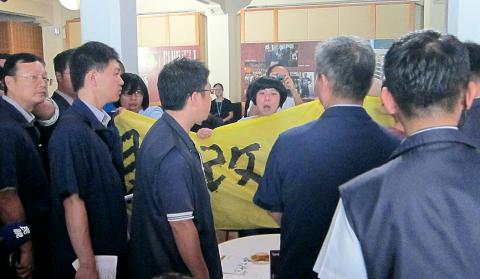
Photo: Lin Hsiang-mei, Taipei Times
The other recipient, Niu, is a well-known actor and director in Taiwan who gained fame with his two box office hits: Monga (艋舺) and Love (愛).
Describing Liu and Niu as “practitioners of cultural movements in Taipei,” Taipei Mayor Hau Lung-bin (郝龍斌) praised Liu for transforming Taipei’s landscape through urban reform, while lauding Niu for documenting the city’s charm and raising its international profile with his popular movies.
However, the award ceremony was interrupted several times by protesters, with various activists of the Losheng Sanatorium preservation movement waving banners and shouting “Save Losheng Sanatorium” and “Don’t be a culture murderer” while Hau gave his speech in the reception at Taipei Zhongshan Hall.
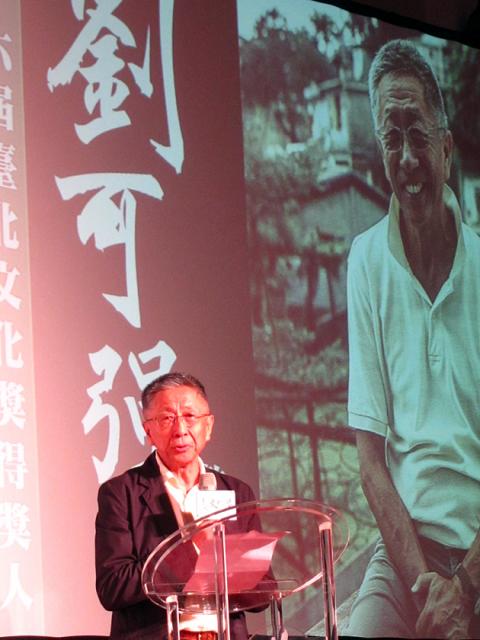
Photo: Lin Hsiang-mei, Taipei Times
“The Control Yuan’s investigation has confirmed that the sanatorium site is not a suitable site on which to build an MRT maintenance depot. As Mayor Hau said, it is crucial to preserve a city’s history and culture, and so we come here today to urge him to save the historical Losheng Sanatiroum,” said one of the protesters, surnamed Wu (巫), after police escorted the activists from the ceremony.
Losheng Sanatorium was completed in the 1930s on a hill in Sinjhuang District (新莊), New Taipei City (新北市), to isolate people with leprosy, since it was believed to be a contagious and incurable disease at the time.
Before the ceremony began, three advocates for the stalled urban renewal project in Shihlin District, known as Wenlin Yuan (文林苑) project, also launched a small protest outside the ceremony, shouting “save Wenlin Yuan” as Hau entered the building.
The urban renewal project is stalled due to opposition from the Wang (王) family, whose houses were torn down by the city government this year to facilitate the approved project. The family and their supporters have been occupying the construction site and refuse to leave.
Even the band Kao Chiu Ching (拷秋勤), who were invited to perform at the ceremony independent of the protests, called on the city government during their performance “not to sacrifice housing justice over any urban renewal project.”
Liu, in his award acceptance speech, also urged the city government to address the controversial urban renewal projects.
“The city government must take a stance on urban renewal and exercise its authority to resolve the disputes while bearing social justice in mind ... I want to encourage Mayor Hau to take a more positive, active role in handling the issues,” he said.
Meawhile, Democratic Progressive Party Taipei City Councilor Tung Chung-yen (童仲彥) yesterday challenged the city government’s decision to honor Niu for what he described a stereotypical portrait of the old Wanhua District (萬華) in his film Monga, a movie about a group of gangsters from the area.
Department commissioner Liu Wei-kun (劉維公) dismissed Tung’s criticism and said Niu was awarded for his innovation in promoting Taipei and representing life in Taipei, and said the award was not given to him based solely on Monga.

Taiwan has received more than US$70 million in royalties as of the end of last year from developing the F-16V jet as countries worldwide purchase or upgrade to this popular model, government and military officials said on Saturday. Taiwan funded the development of the F-16V jet and ended up the sole investor as other countries withdrew from the program. Now the F-16V is increasingly popular and countries must pay Taiwan a percentage in royalties when they purchase new F-16V aircraft or upgrade older F-16 models. The next five years are expected to be the peak for these royalties, with Taiwan potentially earning
STAY IN YOUR LANE: As the US and Israel attack Iran, the ministry has warned China not to overstep by including Taiwanese citizens in its evacuation orders The Ministry of Foreign Affairs (MOFA) yesterday rebuked a statement by China’s embassy in Israel that it would evacuate Taiwanese holders of Chinese travel documents from Israel amid the latter’s escalating conflict with Iran. Tensions have risen across the Middle East in the wake of US and Israeli airstrikes on Iran beginning Saturday. China subsequently issued an evacuation notice for its citizens. In a news release, the Chinese embassy in Israel said holders of “Taiwan compatriot permits (台胞證)” issued to Taiwanese nationals by Chinese authorities for travel to China — could register for evacuation to Egypt. In Taipei, the ministry yesterday said Taiwan
Taiwan is awaiting official notification from the US regarding the status of the Agreement on Reciprocal Trade (ART) after the US Supreme Court ruled US President Donald Trump's global tariffs unconstitutional. Speaking to reporters before a legislative hearing today, Premier Cho Jung-tai (卓榮泰) said that Taiwan's negotiation team remains focused on ensuring that the bilateral trade deal remains intact despite the legal challenge to Trump's tariff policy. "The US has pledged to notify its trade partners once the subsequent administrative and legal processes are finalized, and that certainly includes Taiwan," Cho said when asked about opposition parties’ doubts that the ART was
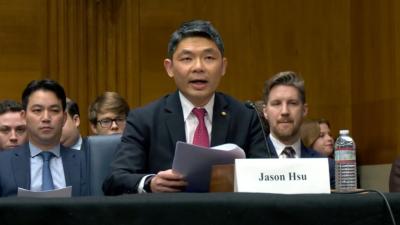
If China chose to invade Taiwan tomorrow, it would only have to sever three undersea fiber-optic cable clusters to cause a data blackout, Jason Hsu (許毓仁), a senior fellow at the Hudson Institute and former Chinese Nationalist Party (KMT) legislator, told a US security panel yesterday. In a Taiwan contingency, cable disruption would be one of the earliest preinvasion actions and the signal that escalation had begun, he said, adding that Taiwan’s current cable repair capabilities are insufficient. The US-China Economic and Security Review Commission (USCC) yesterday held a hearing on US-China Competition Under the Sea, with Hsu speaking on


 RSS
RSS